Jesse James
The StaircaseJesse James is never securely established as a present, speaking character in Lizzy Enders’s account, yet his name and image recur at moments when danger, justice, and belief become difficult to separate. First a celebrated outlaw in the stories and reward posters Lizzy knows from Missouri, he later becomes the alleged visitor and benefactor in Mrs. Lacey’s accounts of Fort Marcy. A poster, a warning note, and a twenty-dollar gold piece give those accounts material form, but Lizzy’s doubts remain: the evidence never proves that Jesse was there or that he was her protector.
Reputation and the Missouri posters
Jesse’s reputation reaches Lizzy before she leaves Independence, Missouri. She and her friend Cassie collect reward posters, and the girls at school dream of seeing him; some claim they have already done so. One schoolmate, Rhoda Markus, insists that Jesse and his brother Frank once ate beside a small fire behind a cooperage and took off their hats to her. The stories make the outlaw a subject of local fascination as well as a wanted man. Lizzy even remembers that the girls hoped he would rob the local bank, a wish that turns his criminal notoriety into a kind of thrilling public entertainment.
Cassie’s gift makes that fascination personal. As Lizzy’s family wagon departs, Cassie runs after it and hands her a paper with instructions to open it when loneliness comes. The paper is Cassie’s best Jesse James reward poster, associated with the Pinkerton Detective Agency’s pursuit of him after he robbed the Missouri-Pacific Railroad of more than fifteen thousand dollars. Attached is Cassie’s promise to care for Lizzy’s cats. The gift thus joins two separations in a single keepsake: Lizzy loses her friend and the animals she had hoped to bring, while carrying away an image of the outlaw from the home she has left.
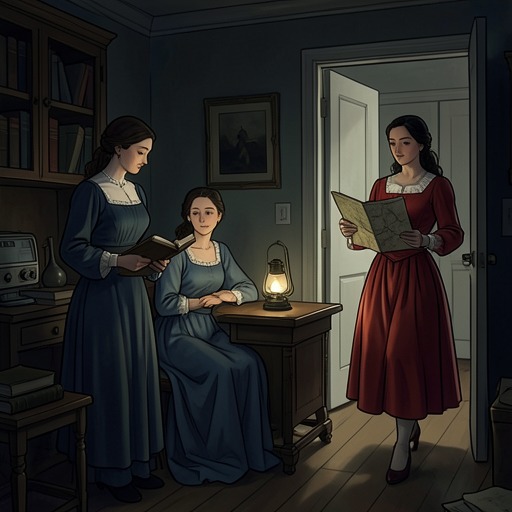
At the convent, Lizzy pastes the poster above her bed. This version offers five thousand dollars for Jesse W. James’s capture. Its place in her room sets it beside objects that carry other kinds of memory: the Virgin statue on Elinora’s shelf contrasts with Lizzy’s own keepsakes, including a tobacco sack from her father, an agate marble from Independence, a locket containing her mother’s hair, and horsehairs wrapped around an eagle feather. Elinora objects to the poster as the image of a drunken heathen. For Lizzy, however, it preserves a link to home and a figure she feels Missouri has a prior claim to, even as the convent gives the image a new, religiously charged setting.
Mrs. Lacey’s Fort Marcy stories
Jesse’s identity changes when Mrs. Lacey speaks of him as someone who visits Fort Marcy. She says he came the previous night, sometimes hides at the fort, and gets along with her. She compares him to the son she lost, Robert, who would be about his age. The claim unsettles Lizzy, who recognizes Mrs. Lacey’s periods of confusion and wonders whether she is in her right mind. Mrs. Lacey’s peaceful manner does not resolve the uncertainty; it makes the possibility of enchantment harder for Lizzy to dismiss even as she distrusts it.
Mrs. Lacey also supplies an explanation for Jesse’s outlawry. She says he told her that the Pinkerton men blew up his house in Missouri and killed his young stepbrother, and that he robs and steals in retaliation against authority. Lizzy recognizes the account as information few people outside Missouri would know, which lends Mrs. Lacey’s story a striking specificity. Yet recognition of the detail is not proof that Jesse confided it to her. The narrative holds both possibilities together: knowledge that seems to confirm the story and a speaker whose reliability Lizzy questions.
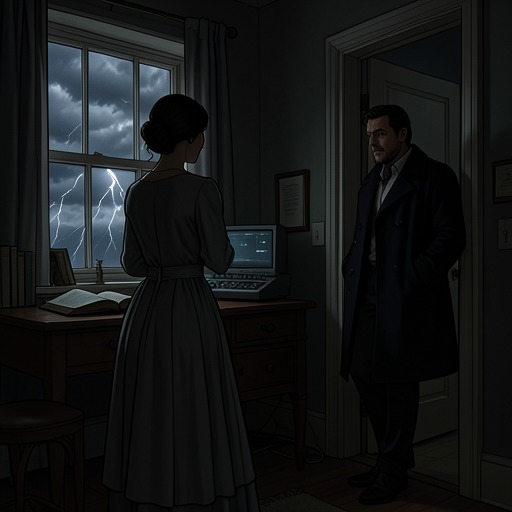
The stories bring a second vulnerable figure into Jesse’s orbit. Mrs. Lacey says Delvina cannot return home because her violent husband may kill her and the baby she is expecting. She further claims that Jesse gave Delvina a twenty-dollar gold piece. When Mrs. Lacey later asks Lizzy to take a note to the cemetery lantern associated with her son, she explains that it is intended for Jesse: the message will warn him that authorities may be nearby and tell him to stay away from the fort. Too weakened by neuralgia to go herself, Mrs. Lacey makes Lizzy her emissary. Lizzy agrees, but does not believe Jesse is at the fort—or even in New Mexico—and does not expect to see him.
The coin and the question of protection
After Delvina dies, she leaves Lizzy the gold piece, with the message that it had been given to her by Jesse. Mrs. Lacey’s account therefore passes from story into an object Lizzy can hold. Alone, Lizzy fingers the coin and wonders whether it truly came from him. She admits to herself that the thought gives it a kind of magic, but also considers another explanation: Delvina’s husband was a thief, and the coin may have been part of an illegal bounty. The object carries competing meanings—possible outlaw generosity, possible stolen money, and the comfort of believing that a famous figure intervened for someone in danger—without deciding among them.
That uncertainty matters when Ramon Baca is shot and the girls discuss the attack. Some focus on its gore and drama; Lizzy instead uses the injury to test the story of her protector. She reasons that if Jesse had shot Baca, Baca would be dead rather than wounded in the leg. The conclusion rules Jesse out as the shooter in her understanding, even while the coin remains in her apron pocket and Mrs. Lacey’s claim that Jesse gave it to Delvina remains unresolved. The text does not identify Jesse as the person who wounded Baca or establish that he rescued Lizzy; Lizzy’s reasoning shows the limit of what she is willing to infer from Mrs. Lacey’s stories.
An absent figure at the story’s close
Jesse remains part of Lizzy’s life through objects and recollection rather than a confirmed encounter. When she leaves the convent four months later, he is reported to be in Nashville, Tennessee, while she travels toward Texas with Elena. Among the possessions she names are her cat, her horse, the coin from Jesse, her books, and the lessons she received from the sisters. The coin has become one item in the practical and emotional inventory she carries into a new life: unlike the poster, which recalls the home she lost, it belongs to the uncertain history she has acquired in New Mexico.
The distinction between Jesse the outlaw and Jesse the supposed benefactor remains central to his narrative role. Lizzy knows his public reputation through posters, rumors, and the Pinkerton pursuit; Mrs. Lacey offers a more intimate account of a man who hides, warns others, and gives money to a woman in danger. But because Lizzy doubts the reported visit and questions the coin’s origin, the novel does not simply replace criminal legend with a confirmed portrait of hidden kindness. Jesse’s presence instead exposes the unstable boundary between evidence and enchantment that Lizzy must navigate: his poster is unquestionably real, while his acts at Fort Marcy remain claims she can neither fully accept nor entirely forget.